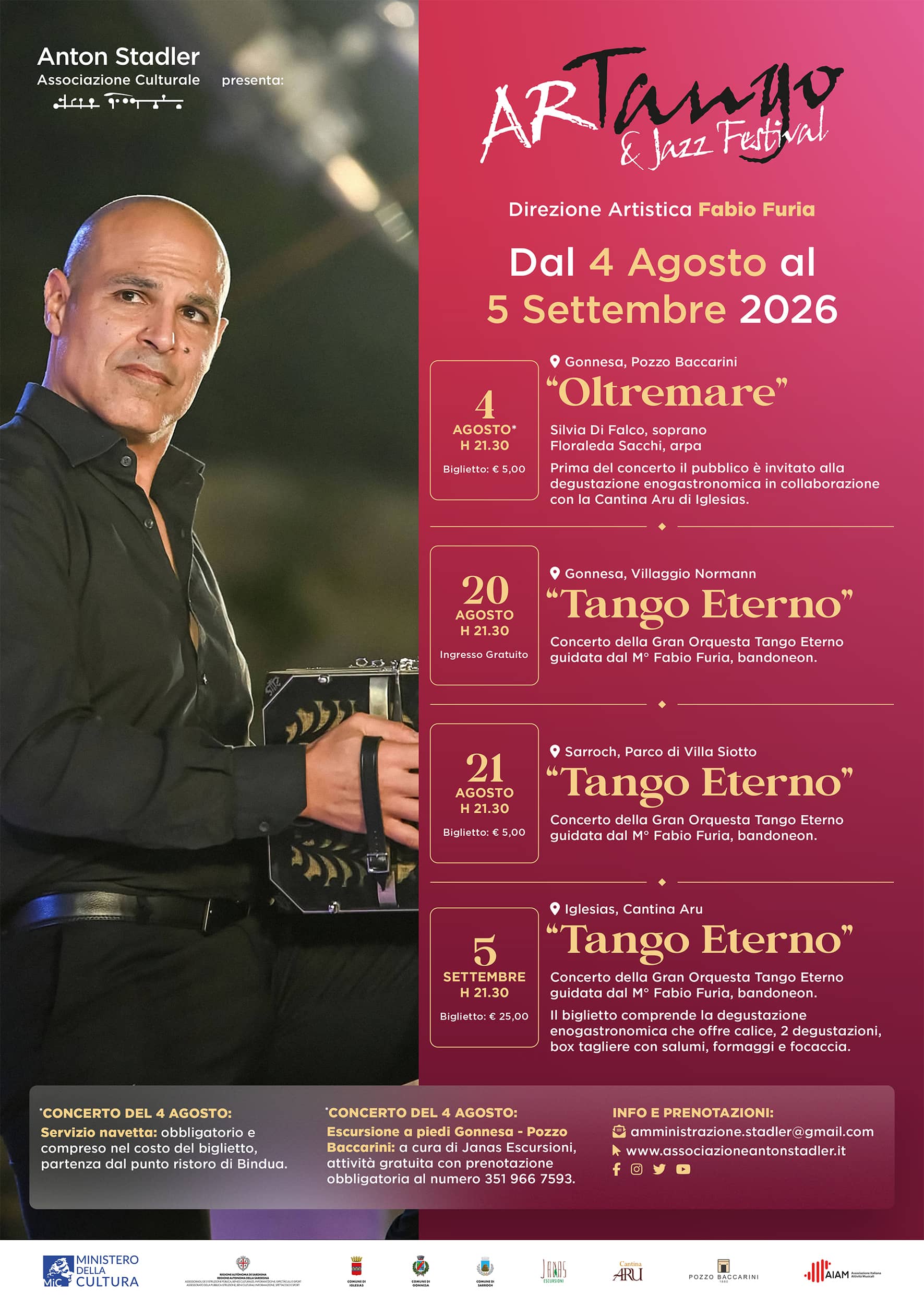
ARTANGO
& JAZZ FESTIVAL
XV edition 2024
Artistic Direction Fabio Furia

XV edition 2024
Artistic Direction Fabio Furia
Astor Piazzolla – The four seasons of Buenos Aires
—
Composed by Astor Piazzolla between 1964 and 1970 for his Quintet, in which he himself played the bandoneon, Las cuatro Estaciones porteñas represent a tribute and a reworking of Vivaldi’s themes, capable of skillfully interweaving cultured tradition, jazz and tango nuevo. The title clearly evokes the Four Seasons of the red priest, more than two centuries distant from Piazzolla’s and strongly linked to the colors of another great seaside city at the antipodes of Argentina: Venice. Seasons “porteñas” because they are linked to the atmosphere and aromas of the great port of Buenos Aires, the beating heart of Argentine tango, its history and tradition.
The pieces, in the order Verano Porteño – Otoño Porteño – Invierno Porteño – Primavera Porteña, initially conceived as stand-alone compositions and composed in different periods, were later presented, by Piazzolla himself, as one and the same true concert. Each tango represents a season. And so Piazzolla drew deep inspiration from observing the passing of the seasons and their influence on daily life, translating the incessant flow of time into marvelous “sound paintings” with strong contrasts in which the rhythm of the tango reigns supreme.
The instrumental texture of Estaciones engages the listener in a refined interplay of affinity and chiaroscuro, tracing enveloping inner landscapes animated by antithetical feelings: from sweetness to sorrow, from moving nostalgia to the most vehement passion.
Astor Piazzolla – double concert for guitar, bandoneon and string orchestra “Hommage à Liège”
—
The Double Concert for guitar, bandoneon and string orchestra, “Hommage à Liège,” is composed on a commission from the International Guitar Festival in Liège, Belgium, where Piazzolla was a guest in 1985 along with his trusted collaborator Cacho Tirao, whose technical advice he often relied on for the writing of many of his guitar works. For the occasion, the two musicians joined forces for the first performance of the Concert for Guitar, Bandoneon and Strings (called, precisely, Homage to Liege), accompanied by the Liege Philharmonic Orchestra conducted by Cuban composer Leo Brouwer.
The composition has a programmatic intent and tells the story of two dancers, represented by the two solo instruments, who, in an intense performance before the audience, interact with each other and the orchestra.
The concert is divided into three movements: Introduction – Milonga – Tango.
The first movement carries the time signature “lentamente” and introduces the concert. It is reserved for the two solo instruments which, without the accompaniment of the orchestra, offer a double rhythm with an almost improvisational character. The guitar begins with a wide solo, giving space for the most refined technical virtuosity. Halfway through the movement, the bandoneon enters, assuming a strongly melodic and expressive role, while the guitar continues in a choral and accompanying pattern. The movement ends with an almost melismatic and contrasting interweaving between the two instruments, generating particularly refined atmospheres and harmonies.
The second half, the Milonga, with its unmistakable rhythmic formula, less pronounced than the Tango, is very melodic and in keeping with tradition. It is an intense dialogue between the soloists, who appear as a reconciled couple: questions and answers and refined unison passages follow one another, accompanied by the pulsating rhythm of the orchestra, in a real dance.
The final movement represents the full expression of Piazzolla’s Tango Nuevo: an intimate and passionate moment in which the voices of the soloists intertwine continuously, punctuated by the typical syncopated rhythm of the tango, which proceeds linearly throughout the piece. The first part of the movement has the form of a fugue: the bandoneon offers the opening theme and is followed by the guitar and then the orchestra. It is the most complex movement in the concert, both rhythmically and in terms of the succession of harmonic successions and numerous clusters: the apotheosis of the tango nuevo.
Martín Palmeri – double concert for bandoneon, guitar, piano and orchestra
—
The concert presents a classical structure in three movements: Allegro-Moderato-Andante.
The first half alternates strongly rhythmic and percussive moments with others of great lyricism, leaving room for contamination between elements of the tango genre and melodies typical of film music. Finally, there is no shortage of virtuosic moments for both solo instruments.
The inspirational second half is very romantic and melodic, expressing great nostalgia and passion.
The third movement appears as a tribute to Osvaldo Pugliese’s interpretative style with the unmistakable percussive elements of the “jumbeado” accompaniment. Further enriching the whole are the cadenzas of the two soloists and a grand finale that is a real explosion of energy.
The undisputed protagonists of the composition are the poignant and passionate timbre of the bandoneon and the refined sonorities of the guitar that intersect incessantly with delicate technicalities and enveloping harmonies. The joining of these two instruments, while appearing so rare and sought-after, has marked the entire history of tango, from traditional to contemporary, making the bandoneon and guitar duo one of the most widely employed ensembles in this musical genre.
The double concert condenses the composer’s desire to pay homage to this fabulous and surprising sound and instrumental union. As always in Martin Palmeri’s work, there recurs, almost like a fingerprint, that winning flair of constantly and skillfully blending the fundamental and defining features of tango, from rhythm to harmonies, together with elements drawn from classical and contemporary music. In this composition in particular, he let his inventiveness join the compositional practice of two musicians for whom he feels the deepest admiration: Pat Metheny and Egberto Gismonti.

Xuefei Yang is acclaimed as one of the world’s finest classical guitarists. Hailed as a musical pioneer – her fascinating journey began after the Cultural Revolution, a period where Western musical instruments and music were banned. Fei was the first-ever guitarist in China to enter a music school, and became the first internationally recognised Chinese guitarist on the world stage.
Her international success has led her to be invited to play in more than 50 countries at numerous prestigious venues.
She has appeared on BBC Radio 4’s Woman’s Hour, the BBC Proms, & documentaries on BBC and China Central Television. The UK classical music station, Classic FM, named Fei as one of the 100 top classical musicians of our time and BBC Music Magazine named her as one of the top six guitarists of the last century.
Gramophone magazine praised her as one of the leading innovators of her generation for continuing to build the guitar repertoire.

Fabio Furia, composer and arranger, is considered one of the most important bandoneonists in Europe.
His concert activity has led him to perform all over the world in the most prestigious concert halls. In 2023 he participated in a tour in China with the Italian Orchestra “I musici” in which he performed at the Shanghai MISA Festival.
He is a member of the Novafonic Quartet with which he has an important concert activity in prestigious halls and institutions.
He is founder and artistic director of the Cultural Associations “Anton Stadler” and “ContraMilonga” and founder of the “Italian Academy of Bandoneon” with which he organizes master classes and concerts with the world’s leading soloists.
He teaches the first academic course in Italy for a three-year degree in Bandoneon at the G.P. da Palestrina Conservatory in Cagliari.
He has several recordings to his credit, and in 2021 a new CD entitled “A Los Maestros” was released with guitarist Alessandro Deiana on the Da Vinci Publishing label.
Martin Palmeri is an Argentine composer, pianist, choir and orchestra conductor.
Winner of numerous international composition prizes, many of his compositions have been recorded in Italy, Latvia, Poland and Argentina.
In 2013 he was invited to perform his work Misa in Buenos Aires “Misatango” at the Basilica of San Ignacio de Loyola in the city of Rome in a concert in honor of Pope Francis, together with the Koln Cathedral Choir (Germany) and the Roma Sinfonietta, organized by the Pro Musica e Arte Sacra Foundation.
2021 marked the centenary of the birth of Astor Piazzolla, for whom M° Palmeri wrote a work entitled “La Pasión según Astor para coro y orquesta,” which was premiered in Frankfurt in July 2022, in a concert organized by the Goldberg publishing house.

An eclectic conductor, he is active in various theaters, orchestras and foundations both in Italy and abroad.
Some of the greatest artists have collaborated with him including: Josè Carreras, Mariella Devia, Sonia Ganassi, Reina Kabaiwanska, Cecilia Gasdia and many others.
Since 2001, he has been Principal Guest Conductor at the Rostov State Musical Theater in Rostov on Don, Russia.
He has also conducted Pop Stars such as: Amy Steward, Ornella Vanoni, Franco Simone and Karima Ammar, and actors of the caliber of Claudia Koll, Giancarlo Giannini, Flavio Insinna, Cesare Bocci, Alessandro Preziosi, and the likes of: Michele Mirabella, Raul Cremona and Massimo Lopez.
In 2012 he received the “Nino Rota” award for lifetime achievement. In 2019 he opened the season at the Bellini Theater in Catania, with The Magic Flute directed by Pierluigi Pizzi. In 2019 he was awarded the honor of “Cavaliere al Merito della Repubblica” by President Sergio Mattarella.


